
About Shashwat Sanatan
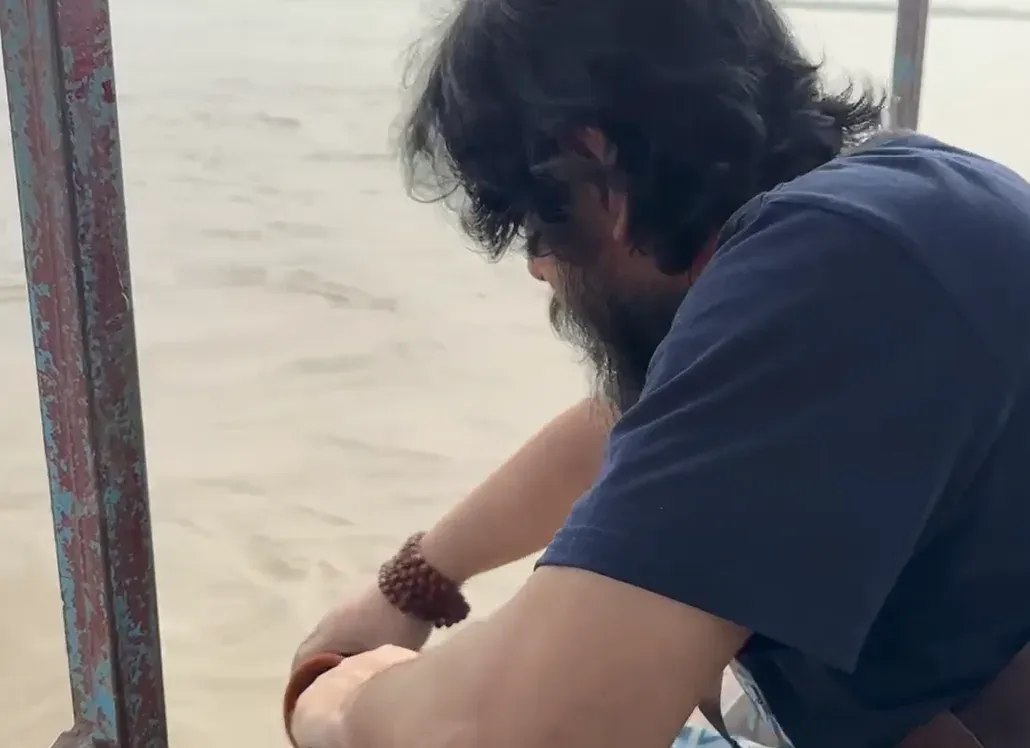
Shashwat Sanatan writes on Sanatan Dharma, Sanskrit, and the devotional soul of Bharat.
He was born in Delhi, into a priestly family long associated with Kalkaji Mandir, the ancient Siddha Peetha of Maa Kalka in the south of the city. In a household like that, the tradition arrives first as something done: the lamp at dusk, the bell, the festival calendar, the long lines of devotees at Navratri. The reading comes later, and when it comes, it explains what the hands already knew.
Between the pandit and the layperson
His writing lives in the space between the two. He works from primary sources in their original languages and writes for the reader who may never open one. Stories are told without embarrassment about the miraculous. Practices are explained as things one can actually do, not as duties to feel guilty for neglecting.
Much modern writing on Hinduism has been worn down by two habits, and he has little patience for either. One is the apologetic reflex that shrinks a vast, living tradition into vague spirituality. The other is the pedantic reflex that buries it under untranslated jargon. The first leaves the reader nothing to hold. The second hands them something too heavy to lift.
A lifelong polyglot, as comfortable with technology as with scripture, he reads the Sanatan tradition alongside the classical literatures of Russia, France, and China. The comparison, in his experience, flatters Sanskrit.
What you will find here
Sanatan Bhumi is where this work is gathered.
Vichar holds essays: what a word really means, why a festival falls when it does, what the tradition actually says about the questions people are asking today.
Vidya is study in tracks, taken one step at a time: the Gita beyond its famous verses, the Upanishads in their own voice, the sixty-four Yoginis, Jyotisha, Tantra, the stotras, and Sanskrit itself.
Panchang gives each day as the tradition counts it: tithi, nakshatra, yoga, karana and vara.
Akhand Bharat reads the civilisation's own map of itself through its history and its texts: what was, what is, and what could be.
Gurukul is the home of the children's books.
How the writing is kept honest
A few rules hold across everything on this site.
Sanskrit always appears in Devanagari, with a transliteration and a plain meaning. A bare transliteration is never enough.
Every verse is cited to its text and number, so that any reader can check it. No shloka is composed and passed off as scripture.
Where a claim rests on family or lineage tradition, the page says so. Where something is his own reading, the page says that too.
Images of the Devas and Devis are traditional and credited. If an image has been newly made, the caption tells you.
Each page is written in Hindi and English, and each language is given its own text instead of a word-for-word copy of the other.
For children, and the families around them
A great deal of his work begins with children. If we want to rediscover our roots, the most meaningful road may be the one our children will walk. The Shashwat Sanatan Series brings the tradition's stories, deities, sages, sacred places, and values to young readers, and is written to awaken curiosity, never to impose belief.
Children today must learn science, technology, and new languages, and meet the modern world with confidence. None of that asks them to forget where they come from. A child who knows their heritage is not bound by the past; that knowledge gives them firm footing for the future. Holding the balance is, in the end, the work of parents, and the books are meant to be shared: grandparents, parents, and children reading the same stories and asking the same questions again.
If a child closes one of these books and asks, “Tell me more about this…”, the book has done its work.
The larger purpose
Beneath all of it lies one aim: the revival of Sanatan Dharma in its depth, its confidence and its true values.
Depth, because the tradition has reached many of us in fragments: a festival here, a half-remembered mantra there, a picture on the wall whose story no one in the house can tell any more. The texts, the reasoning behind the rites, and the long debates of the schools deserve to be known again, and not only by specialists.
Confidence, because for generations educated Hindus were taught to speak of their own dharma in an apologetic voice, explaining it away before anyone had asked. A civilisation that gave the world the Upanishads and the Gita, Panini's grammar and Kalidasa's poetry has no reason to lower its eyes.
True values, because a revival is measured by how dharma is lived. Truthfulness and restraint, reverence for the Mother in every form, care for elders and children, the guest received as a god: अतिथिदेवो भव, atithi-devo bhava, “let the guest be a god to you” (Taittirīya Upaniṣad 1.11.2). Without these, the flags and slogans mean very little.
And beyond the dharma, Bharat. His hope is to see Bharat rediscover and fulfil its civilisational destiny: a country that knows its own story and tells it in its own words, keeps its tirthas and its languages alive, and has something of its own to offer a world that is running short of meaning. A civilisation that is sure of itself never needs to diminish anyone else.
A note on the name
Shashwat Sanatan is a pen name. The author writes under other names too, but keeps his devotional work in a house of its own: quiet, rooted and undisturbed.
Those who share this aim and would like to support, collaborate, or simply walk alongside are welcome to write: [email protected]
Dedication
This site is dedicated to his late parents.
To his father, a brilliant man who served Bharat in silence, one of the “unknown men” whose work is never credited and seldom spoken of. He was the first of them his son ever knew. Men of that service leave no record of what they did and ask for none; their reward is that the country sleeps safely without ever learning their names. From him came discipline, svābhimān, and a love of country that expected nothing back. He taught, mostly without words, that self-respect and pride are different things, and that the truest service is the kind no one will ever thank you for.
To his mother, who taught him the meaning of love and compassion, and why the Mother Goddess lives at the heart of Sanatan Bhumi. Long before he read a single stotra, he had already seen in her what the stotras describe: a patience that did not run out, a care that did not keep accounts, a faith that never needed to announce itself. Whenever these pages speak of the Devi as Mother, some part of it is about her.
Between them, they gave him the two halves of everything this work tries to be: his father's steel and his mother's tenderness, duty and devotion, the love of the motherland and the love of the Mother.
जननी जन्मभूमिश्च स्वर्गादपि गरीयसी jananī janma-bhūmiś ca svargād api garīyasī
One's mother and one's motherland are greater even than heaven.
A line traditionally attributed to the Rāmāyaṇa, though it does not appear in the critical edition.
His parents are the reason he would not hesitate for a moment to give his own life in the service of Bharat Mata and of Sanatan Bhumi. Whatever is good in these pages is laid at their feet.